
The Four Fundamental Types of Nanostructured Materials
Nanostructured materials represent a revolutionary class of substances engineered at the nanoscale (typically 1 to 100 nanometers). At this scale, materials exhibit unique physical, chemical, and biological properties that differ significantly from their bulk counterparts. These properties are not just a matter of size but arise from quantum effects and the dramatically increased surface area-to-volume ratio. The systematic organization of matter at the nanoscale has given rise to four distinct categories, each defined by the number of dimensions that are outside the nanoscale range. Understanding these types is crucial for advancing fields from electronics to medicine.
1. Zero-Dimensional (0D) Nanostructures
Zero-dimensional nanomaterials are defined by having all three dimensions confined to the nanoscale. They are essentially nanoscale particles with no dimension extending beyond 100 nm. These materials are often referred to as nanoparticles, nanodots, or quantum dots (when they exhibit quantum confinement effects).
Their confined structure leads to discrete electronic states, resulting in size-tunable optical and electrical properties. For instance, the color of a quantum dot's fluorescence can be precisely controlled by changing its size.
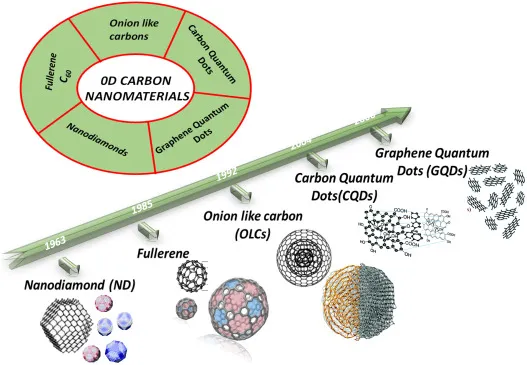
Key Examples and Applications:
- Quantum Dots: Used in high-efficiency displays (QLED), solar cells, and biomedical imaging as fluorescent labels.
- Metal Nanoparticles (e.g., Gold NPs): Utilized in catalysis, sensors, and photothermal therapy for cancer.
- Fullerenes (Buckyballs): Carbon-based 0D structures used in organic photovoltaics and as antioxidants.
2. One-Dimensional (1D) Nanostructures
One-dimensional nanomaterials have two dimensions confined to the nanoscale, while one dimension remains extended. This class includes structures that are long and thin, providing a high aspect ratio (length-to-diameter ratio).
Their elongated shape facilitates efficient electron transport along the long axis, making them ideal for charge conduction. They also offer excellent mechanical strength and flexibility.
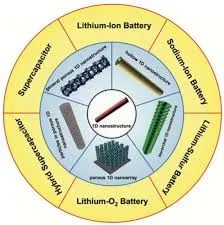
Key Examples and Applications:
| Material | Description | Primary Applications |
|---|---|---|
| Carbon Nanotubes (CNTs) | Rolled sheets of graphene, single-walled or multi-walled. | Nanoelectronics, reinforced composites, conductive films. |
| Semiconductor Nanowires | Solid rods of materials like silicon or zinc oxide. | Transistors, sensors, LEDs, and piezoelectric generators. |
| Nanofibers | Polymeric or ceramic fibers produced by electrospinning. | Advanced filtration, tissue engineering scaffolds, wound dressings. |
3. Two-Dimensional (2D) Nanostructures
Two-dimensional nanomaterials are characterized by having only one dimension (thickness) at the nanoscale, while the other two dimensions are extended. These are ultra-thin, sheet-like materials, often just one or a few atomic layers thick.
This planar geometry grants them exceptional surface area and unique electronic properties, such as high electron mobility and tunable bandgaps. They are often layered materials where in-plane bonds are strong, while interlayer forces are weak (van der Waals).
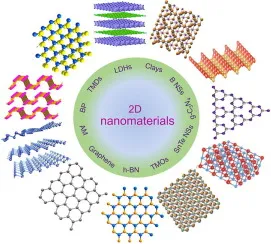
Key Examples and Applications:
- Graphene: A single layer of carbon atoms in a hexagonal lattice. Applications include flexible electronics, supercapacitors, and high-strength composites.
- Transition Metal Dichalcogenides (TMDs) like MoS2: Semiconductor alternatives to graphene, used in ultrathin transistors and optoelectronics.
- MXenes: Ceramic-like conductive sheets used in energy storage (batteries, supercapacitors) and electromagnetic interference shielding.
4. Three-Dimensional (3D) Nanostructured Materials
Three-dimensional nanostructured materials are bulk materials that are composed of nanoscale building blocks or feature a nanoscale architecture throughout all three dimensions. The individual structural units themselves (like grains, pores, or phases) are nanoscale, but the overall material is macroscopic.
This category focuses on bulk materials with nanoscale features, which combine the novel properties of nanomaterials with the handling and structural advantages of bulk solids.
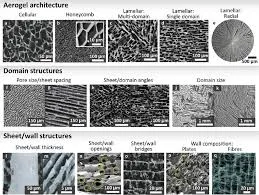
Key Examples and Applications:
| Type | Structure | Applications |
|---|---|---|
| Nanocrystalline Materials | Bulk solids with crystal grains sized between 1-100 nm. | High-strength metals and alloys, wear-resistant coatings. |
| Nanoporous Materials (e.g., Aerogels) | Highly porous networks with nanoscale pores. | Superior thermal insulation, catalysis, gas storage. |
| Nanocomposites | Bulk matrix (polymer, ceramic) reinforced with nanofillers (CNTs, nanoparticles). | Lightweight strong materials for aerospace, automotive, and packaging. |
Conclusion
The classification of nanostructured materials into zero-dimensional, one-dimensional, two-dimensional, and three-dimensional types provides a fundamental framework for understanding and harnessing the power of the nanoscale. Each category offers a distinct set of properties—from the quantum effects in 0D dots to the high conductivity of 1D tubes, the unparalleled surface area of 2D sheets, and the structural robustness of 3D nanocomposites. This diversity is driving innovation across virtually every technological sector, promising more efficient energy solutions, advanced medical treatments, and next-generation electronic devices. As synthesis and characterization techniques continue to advance, the boundaries between these types will further blur, leading to even more sophisticated hierarchical and hybrid nanomaterials.