
The Role of Optical Coating Materials in Renewable Energy
The global transition towards sustainable energy sources has placed unprecedented demands on technology to maximize efficiency and minimize cost. At the heart of this transformation, particularly in solar and related technologies, lies a sophisticated yet often overlooked field: optical coatings. These nanoscale layers of material, applied to surfaces to manipulate light, are critical enablers for harnessing, converting, and managing radiant energy. This article explores the pivotal functions of optical coating materials across various renewable energy applications, highlighting their contribution to performance enhancement and system durability.
Fundamentals of Optical Coatings
Optical coatings are thin films engineered to alter the reflection, transmission, absorption, and polarization of light. By depositing layers of dielectric or metallic materials—such as silicon nitride (Si₃N₄), titanium dioxide (TiO₂), silicon dioxide (SiO₂), or silver (Ag)—with precise thicknesses, specific optical interference effects are achieved. These effects allow designers to create surfaces with tailored properties, turning ordinary glass or semiconductor substrates into highly functional optical components. The performance hinges on controlling refractive indices and layer thickness at scales smaller than the wavelength of light.
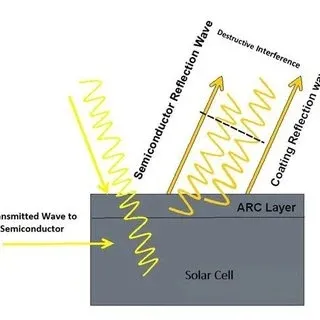
Figure 1: Schematic of a multi-layer anti-reflective coating on a solar cell, reducing reflection losses.
Key Applications in Solar Energy Technologies
Solar photovoltaics (PV) and concentrated solar power (CSP) are the primary beneficiaries of advanced optical coatings.
Anti-Reflective Coatings for Photovoltaics
The most widespread application is anti-reflective (AR) coatings on PV modules. A significant portion of incident sunlight is typically reflected away from bare silicon or glass surfaces. Multi-layer AR coatings, often based on SiO₂ and TiO₂, dramatically reduce this reflection, allowing more photons to reach the semiconductor absorber layer. This directly increases the short-circuit current and overall module efficiency. Modern high-efficiency cells, including PERC and heterojunction designs, rely on complex, passivating AR coating stacks.
Reflective and Protective Coatings for CSP
In CSP systems, mirrors (heliostats) and parabolic troughs must reflect a maximum amount of sunlight towards a thermal receiver. Enhanced aluminum or silver mirrors are coated with protective dielectric layers. These coatings serve a dual purpose: they maximize reflectivity across the solar spectrum and provide robust environmental protection against corrosion, abrasion, and UV degradation, ensuring long-term field performance in harsh desert environments.
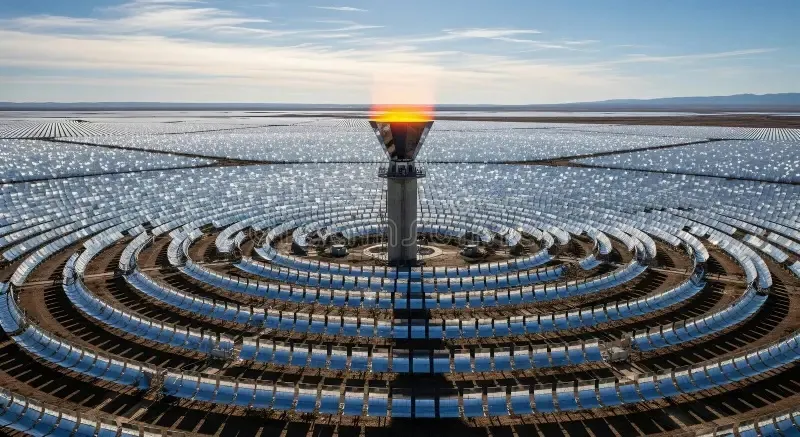
Figure 2: A concentrated solar power plant utilizing mirrors with high-reflectivity optical coatings.
Selective Absorber Coatings for Solar Thermal
For solar thermal water heating and some CSP receivers, the goal is to absorb solar radiation while minimizing re-radiation of infrared heat. Selective absorber coatings are engineered to have high absorptance in the solar spectral range (0.3-2.5 µm) and very low emittance in the infrared range (>2.5 µm). These coatings, often using cermet (ceramic-metal composite) materials, are crucial for achieving high thermal conversion efficiencies at elevated temperatures.
Enhancing Durability and Longevity
Beyond boosting initial efficiency, optical coatings are vital for the durability of renewable energy systems. They act as the first line of defense against environmental stressors. For instance, hydrophobic and anti-soiling coatings can be applied over AR layers to repel water and dust, maintaining high light transmission and reducing cleaning frequency. Similarly, UV-blocking and hermetic encapsulation coatings protect sensitive organic photovoltaic (OPV) and perovskite solar cell materials from photo-degradation and moisture ingress, which are key challenges for these emerging technologies.
| Coating Type | Primary Material Examples | Function in Renewable Energy | Key Benefit |
|---|---|---|---|
| Anti-Reflective (AR) | SiO₂, TiO₂, MgF₂ | Minimize reflection losses on PV glass & cells | Increases light absorption & PV efficiency |
| High-Reflectivity | Ag, Al with dielectric protectors | Maximize sunlight reflection in CSP mirrors | Enhances thermal energy collection |
| Selective Absorber | Cermets (e.g., Ni-NiO, Mo-SiO₂) | Absorb solar radiation, suppress IR emission | Improves solar-thermal conversion efficiency |
| Protective / Anti-Soiling | Hydrophobic SiO₂-based layers | Repel water, dust, and resist environmental wear | Maintains performance, reduces maintenance |
Future Trends and Challenges
The future of optical coatings in renewables is geared towards multifunctionality, broadband performance, and lower-cost deposition methods. Research is focused on developing "smart" coatings that adapt to environmental conditions, such as thermochromic layers that modulate IR emittance. Plasmonic and metamaterial-based coatings promise unprecedented control over light for next-generation ultra-thin solar cells. However, challenges remain in scaling up advanced deposition techniques like atomic layer deposition (ALD) cost-effectively and in ensuring the long-term stability of complex coating stacks under real-world, multi-decade operational lifetimes.
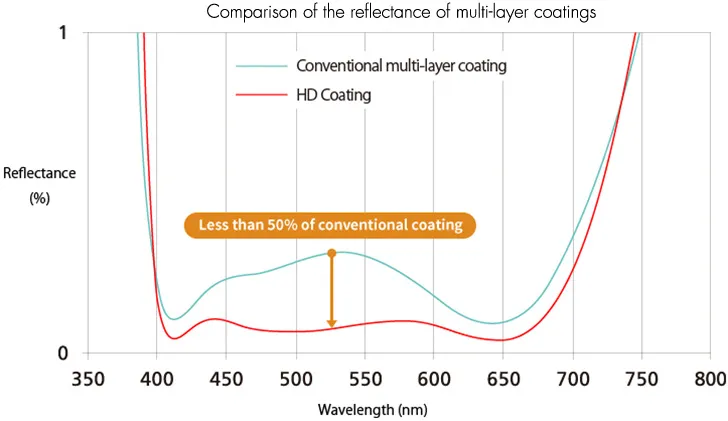
Figure 3: Spectral response comparison showing the superior broadband performance of an advanced optical coating.
Conclusion
Optical coating materials are indispensable, though often invisible, workhorses in the renewable energy landscape. By precisely engineering the interaction between light and matter, they significantly boost the efficiency, durability, and economic viability of solar technologies. As the demand for clean energy intensifies, continued innovation in optical coatings will play a central role in pushing the performance boundaries of photovoltaic modules, solar thermal collectors, and concentrated solar power systems, thereby accelerating our global sustainable energy future.