
Review on Thermal Energy Storage with Phase Change Materials
Thermal Energy Storage (TES) using Phase Change Materials (PCMs) has emerged as a pivotal technology for enhancing energy efficiency, managing demand-supply gaps, and integrating renewable energy sources. This review examines the fundamental principles, classification, applications, and current challenges of PCM-based TES systems, highlighting their role in a sustainable energy future.
1. Introduction to Thermal Energy Storage (TES)
Thermal Energy Storage is a critical technology that allows the capture and retention of thermal energy for later use. It plays a vital role in balancing energy demand and supply, improving the efficiency of energy systems, and facilitating the use of intermittent renewable sources like solar and wind energy. Among various TES methods, latent heat storage using Phase Change Materials has gained significant attention due to its high storage density and nearly isothermal operation during charging and discharging.
2. Fundamentals of Phase Change Materials (PCMs)
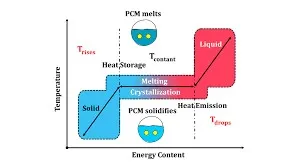
PCMs are substances that absorb and release large amounts of latent heat when they undergo a phase transition, typically between solid and liquid states. This latent heat is substantially higher than sensible heat storage capacity, allowing for compact and efficient storage systems. The phase change occurs at a relatively constant temperature, making PCMs ideal for applications requiring precise temperature control.
2.1 Key Properties of Effective PCMs
An ideal PCM should possess high latent heat of fusion, suitable phase change temperature for the intended application, high thermal conductivity, chemical stability, non-toxicity, low cost, and minimal supercooling. No single material meets all criteria perfectly, leading to extensive research into material blends and composites.
3. Classification of Phase Change Materials
PCMs can be broadly categorized into three main groups: organic, inorganic, and eutectic mixtures. Each category has distinct advantages and limitations.
| PCM Type | Examples | Advantages | Disadvantages | Common Applications |
|---|---|---|---|---|
| Organic PCMs | Paraffins, Fatty Acids | Chemically stable, non-corrosive, minimal supercooling | Low thermal conductivity, flammable | Building insulation, textiles |
| Inorganic PCMs | Salt Hydrates, Metallic alloys | High latent heat, high thermal conductivity, non-flammable | Supercooling, phase segregation, corrosive | Solar thermal plants, industrial waste heat recovery |
| Eutectic Mixtures | Organic-Organic, Inorganic-Inorganic blends | Sharp melting point, tunable properties | Complex formulation, cost | Temperature-controlled packaging, electronics cooling |
4. Major Application Areas of PCM-based TES
The integration of PCMs spans numerous sectors, driven by the global need for energy conservation and management.
4.1 Building and Construction
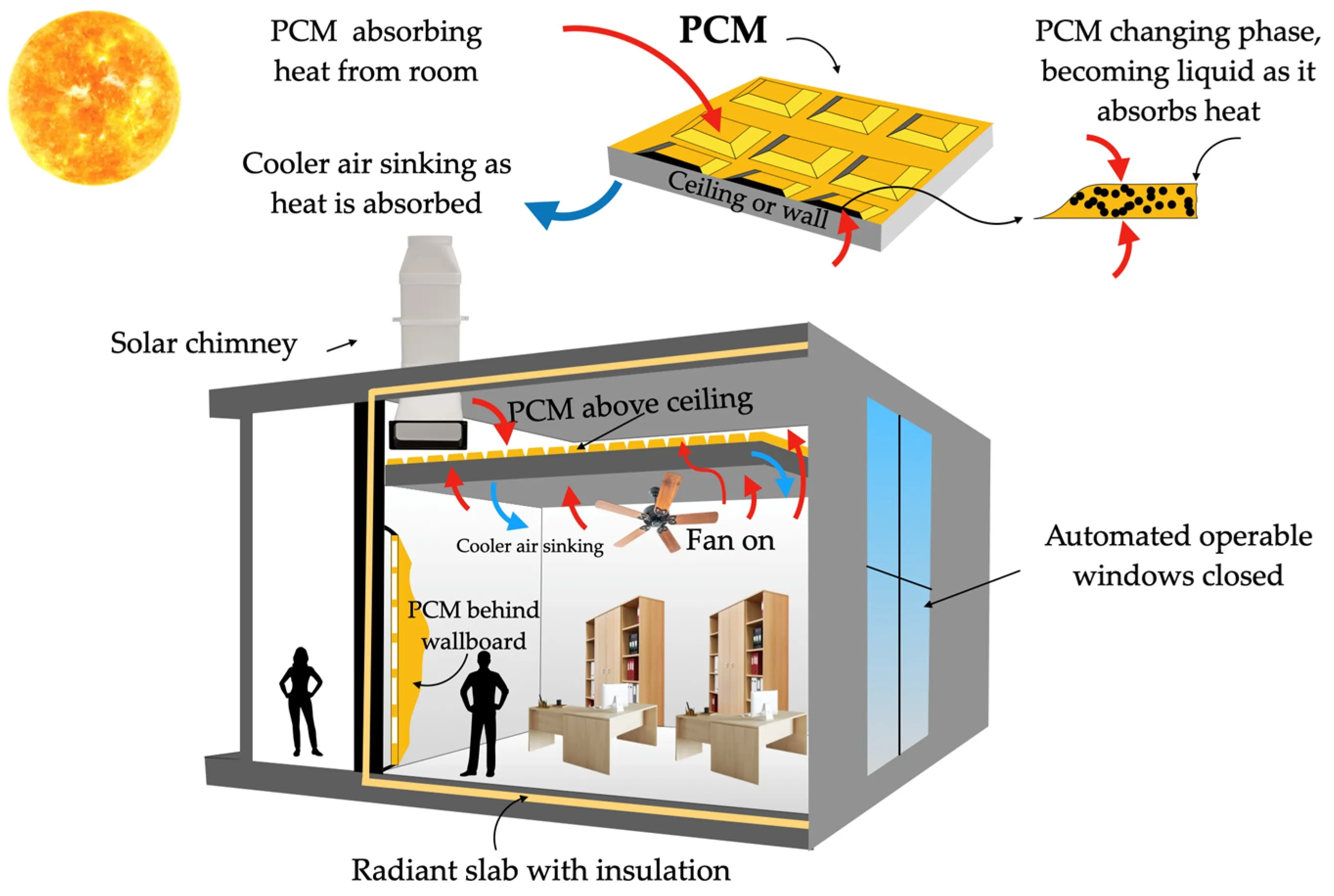
In buildings, PCMs are incorporated into walls, ceilings, and floors to stabilize indoor temperatures, reduce heating and cooling loads, and enhance thermal comfort. This application significantly cuts energy consumption in HVAC systems.
4.2 Solar Thermal Energy Systems
PCMs store excess solar thermal energy collected during the day for use at night or during cloudy periods, improving the reliability and dispatchability of solar power systems.
4.3 Electronics Thermal Management
With the miniaturization of electronics, managing heat flux has become critical. PCMs are used to absorb transient heat pulses, preventing overheating and improving device reliability.
4.4 Textiles and Clothing
Incorporating microencapsulated PCMs into fabrics provides adaptive insulation, maintaining a comfortable microclimate for the wearer in varying environmental conditions.
5. Encapsulation and Heat Transfer Enhancement
A significant challenge with PCMs, especially organics, is their low thermal conductivity, which limits charge/discharge rates. Two primary strategies address this:
5.1 Micro and Macroencapsulation
Encapsulating PCM in tiny capsules (micro) or larger containers (macro) prevents leakage during the liquid phase, increases surface area for heat transfer, and provides structural stability.
5.2 Thermal Conductivity Enhancers
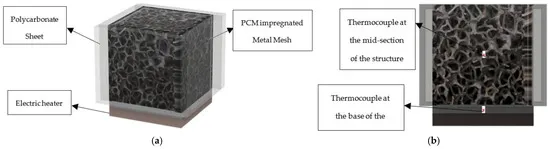
Adding high-conductivity materials like metal fins, nanoparticles (e.g., graphene, carbon nanotubes), or metal foams creates composite PCMs with significantly improved thermal performance.
6. Current Challenges and Future Perspectives
Despite progress, several hurdles remain. Long-term stability and reliability over thousands of cycles need further validation. Material costs and the energy density of commercial systems must improve for widespread adoption. Future research is directed towards developing novel bio-based and nano-enhanced PCMs, optimizing system design using AI, and creating standardized testing protocols. The ultimate goal is to develop cost-effective, high-performance, and sustainable PCM solutions that are integral to smart grids and zero-energy buildings.
7. Conclusion
Thermal Energy Storage with Phase Change Materials represents a transformative approach to energy management. By leveraging the high latent heat of phase transitions, PCMs enable efficient, compact, and temperature-stable storage solutions. While challenges in thermal conductivity, stability, and cost persist, ongoing research and technological innovations continue to broaden their applicability. The successful integration of PCM-based TES across sectors is crucial for achieving global energy sustainability and resilience goals.